
By Joey Ricard - November 19, 2026
More AI agents don’t necessarily mean better AI. Here’s how enterprises should choose the right architecture.
As enterprises move from AI experimentation to real-world deployment, a critical question is emerging: Should businesses build one powerful AI agent or deploy multiple specialized agents working together?
Multi-agent systems promise greater flexibility, specialization, and scalability. But they also bring higher costs, added complexity, and new operational challenges.
The smartest approach isn’t always the most sophisticated one.
Single-agent systems use one AI agent to handle tasks, make decisions, and interact with tools or APIs.
For example, an AI customer support agent can retrieve account information, answer questions, and initiate approved support actions without involving other agents.
Multi-agent systems distribute responsibilities across multiple specialized AI agents that collaborate to complete complex tasks.
For example, an enterprise market intelligence system might use separate agents for competitor research, financial analysis, and regulatory monitoring, with another component consolidating the results.
As explained in Microsoft’s AI Agent Orchestration Patterns, both approaches have advantages, but their suitability depends on the workflow.
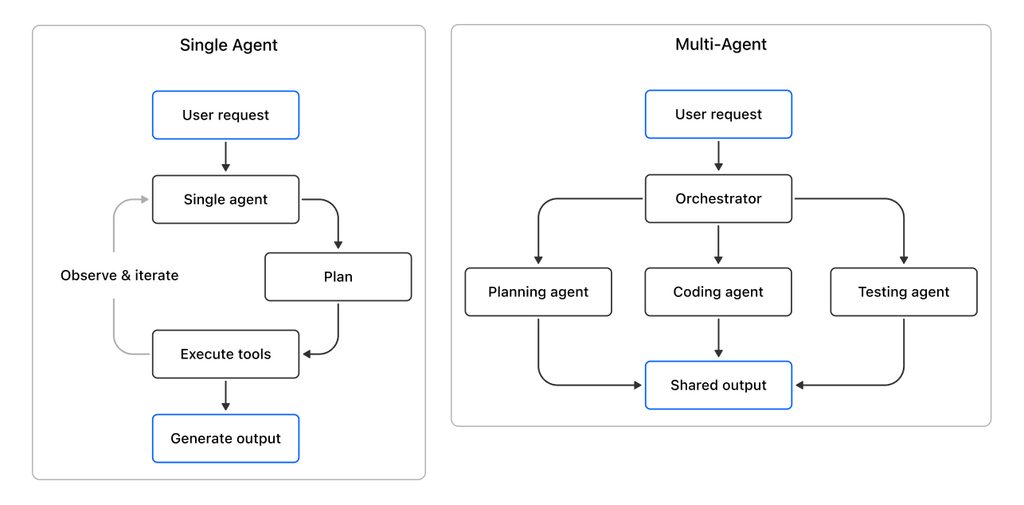
The key takeaway: Adding agents should solve a measurable problem, not simply make an architecture appear more advanced.
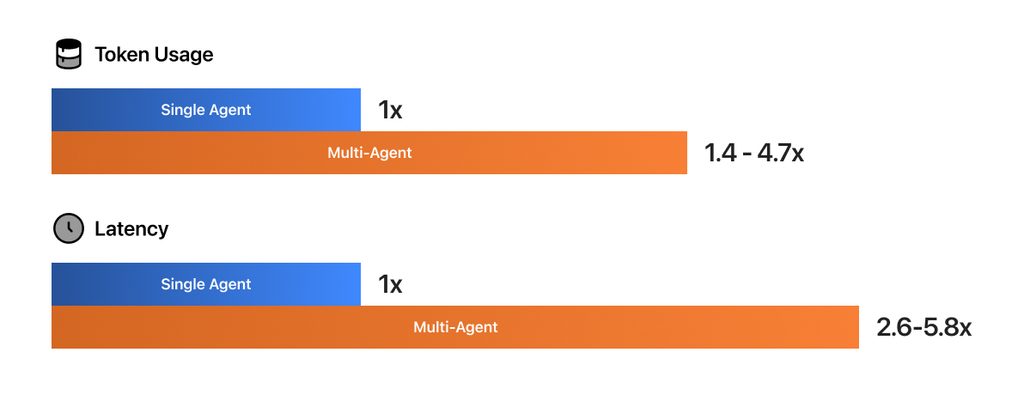
A November 2026 research preprint evaluating enterprise AI agent architectures found that coordinated architectures used 1.4–4.7× more tokens and experienced 2.6–5.8× higher latency than the single-agent baseline.
The study also found no universally superior architecture across all evaluated tasks.
These findings don’t mean multi-agent systems are ineffective. They show that coordination introduces overhead, and the benefits depend on how well the architecture matches the task.
More agents can mean more capabilities, but also more cost and complexity.
Example: An internal IT support assistant handling employee requests, troubleshooting, and ticket creation.
Example: An enterprise research platform combining market analysis, financial intelligence, and regulatory insights.
As highlighted in Anthropic’s guide to building effective agents, organizations should begin with simpler solutions and introduce complexity only when it provides meaningful benefits.
However, some workflows are better handled through traditional automation with targeted AI capabilities rather than autonomous agents.
Architecture decisions go beyond model performance.
Multi-agent systems introduce additional communication paths, decision points, and potential failure scenarios.
Enterprises must consider:
These requirements matter for both architectures, but coordination makes them more challenging in multi-agent environments.
Google Cloud’s multi-agent AI architecture guidance offers further insight into designing coordinated enterprise AI systems.
The most practical strategy is simple:
Start with the smallest architecture that can reliably solve the business problem.
Build a single-agent prototype, measure its performance, and identify genuine limitations before introducing additional agents.
Evaluate success through task accuracy, response time, operational cost, reliability, and business impact.
If specialized agents produce measurable improvements, expand the architecture incrementally.
If a single agent delivers the required outcomes, adding more agents may only increase complexity.
Multi-agent AI represents an important architectural opportunity, but it isn’t automatically the future of every enterprise workflow.
The most effective AI systems won’t necessarily have the most agents. They’ll be the ones that deliver reliable outcomes without unnecessary complexity.
For enterprises, the goal isn’t to build more AI agents. It’s to build smarter AI systems.
At Klizo Solutions, we help businesses design scalable software and AI solutions aligned with real operational needs.
Ready to build enterprise AI that delivers measurable value? Connect with Klizo Solutions.

Previous article

Joey Ricard
Klizo Solutions was founded by Joseph Ricard, a serial entrepreneur from America who has spent over ten years working in India, developing innovative tech solutions, building good teams, and admirable processes. And today, he has a team of over 50 super-talented people with him and various high-level technologies developed in multiple frameworks to his credit.



Klizo Solutions Pvt. Ltd. is a specialized development company. Let us build your solution.


